As Israel approaches another election on October 27, a familiar anxiety is settling over the country: that the societal divisions exposed post-October 7 will continue to widen under political campaign pressure. One Jewish Federation Bay Area grantee in Israel is betting on a different outcome — not one that stems from more dialogue, but from institutions built to make cooperation last.
A Bet on Structure, Not Just Sentiment
Living Together was founded to not only address ideological polarization in Israeli society but structural as well. Dialogue alone, they argue, tends to evaporate once a crisis fades. Lasting impact comes from institutional bodies, dedicated funding, and formal mandates that require people to keep showing up to the table, year after year.
Supporting Living Together means investing in a more resilient Israeli democracy through structural solutions. And as Israelis head to the polls this October, that infrastructure may be exactly what holds the country together.
A Region Chooses Partnership
Living Together has convened a regional tourism task force in the Gaza Envelope (Western Negev) spanning kibbutzim, Bedouin communities, ultra-Orthodox cities, and development towns to support communities hit hardest on October 7. Using shared economic interest as an entry point, the group is now being formalized into a permanent Regional Tourism Directorate, incentivizing these municipalities to keep sharing resources and shaping a narrative that honors each community’s identity.
Additionally, Living Together runs Shenihye Re’uyim (“That We May Be Worthy”), an initiative led by bereaved families, wounded soldiers, and returned hostages pressing politicians and leaders in the media toward a more respectful public discourse. The campaign is pushing for something Israel has never had: a Knesset committee or national directorate that makes social cohesion a permanent, funded state priority.
Bridging Academic and Ideological Divides
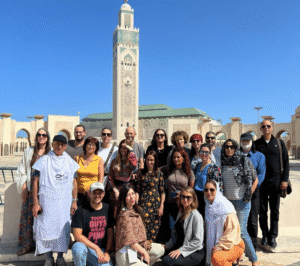
Israel’s research and policy institutes play a significant role in shaping public discourse and policy, but professional connections across ideological lines have grown increasingly rare. In partnership with the Paris Center at the University of Haifa, Living Together has convened an active working group of researchers and leaders from across the political spectrum to develop practical tools for navigating disagreement. The relationships built through this network are laying the groundwork for greater collaboration and strengthening democratic resilience, including the capacity to work together in moments of national crisis.
Why This Matters Right Now
Israel’s next election is set for October 27, and polarized political campaign rhetoric threatens to deepen the very divisions Living Together works to heal.
Barak Loozon, director of the Federation’s Israel office, calls this election a genuine test of Israeli democracy. He sees Israel at a crossroads on three fronts: its internal social contract, the Jewish diaspora-Israel relationship, and its role in a changing Middle East (Living Together’s work speaks directly to the first).
Loozon also points to a related Federation supported effort: a six-month process convening bereaved families and returned former hostages, including Druze, Bedouin, Haredi, Arab, religious, secular, and the left and right, around their shared experiences. The resulting campaign, built on the Hebrew wordplay of machane (which means both camp and common denominator), urges Israelis to vote however they choose without losing their common ground.
Shared Ground, Shared Action

That’s also the logic behind the Federation’s own Israel strategy, which is organized around three pillars: Rebuilding Together, Civil Society & Democracy, and Shared Society, where social cohesion isn’t treated as an end in itself, but as the means to rebuilding a stronger Israel.


