Courage of the Heart — Ruby Lion of Judah Journey to a Healing Israel
The Federation
Share
Founded in 1972, the Jewish Federations of North America Lion of Judah program has become an international symbol of strength, sisterhood, and an unwavering commitment to the global Jewish community. Uniting nearly 20,000 Jewish women philanthropists from 141 communities, this program raises over $250 million annually for critical Jewish causes. Every year, each Lion gives $5k or more to her local Federation’s Annual Campaign. Susie Sorkin, a Lion for more than 20 years, has endowed her gift.
There is an image that Susie Sorkin carries in her mind from her first visit to Israel after October 7 — the long arrivals ramp at Ben Gurion Airport, its walls plastered with poster after poster bearing the faces of hostages. When she returned this past March as part of the Ruby Lion of Judah mission, only one remained.
“This time,” Susie recalled. “There was just Ran Gvili.”
That single poster told the story of a country that had endured two years of unimaginable loss — and was, somehow, still there. For Sorkin, a longtime Lion of Judah from the Bay Area, that image encapsulated why she had come back: to connect, bear witness, and to understand what comes next.
The Pull to Return
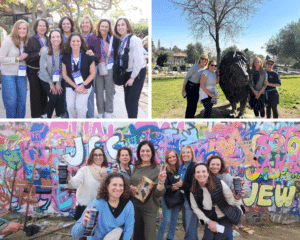
More than 100 women philanthropists from 32 Federations joined the Ruby Lion of Judah mission, co-chaired by Kim Hartman, Carolyn Gitlin, and National Women’s Philanthropy Chair Sherri Ketai. Dubbed Ometz Lev— “Courage of the Heart” — the six-day trip was designed to illuminate the war’s ongoing impact on women, children, and families, and to show how Federations across North America are helping to rebuild Israeli society.
For Susie, the draw was both personal and communal. “I visited Israel in January 2024 and wanted to return to see what has changed, how Israel is moving forward, and where some of the pain points are,” she said. But it was more than curiosity that brought her back. “I have found being part of National Women’s Philanthropy Board to be incredibly rewarding, in a way I think I was not necessarily expecting. And I’ve met some incredible women that I just want to spend time with.”
The scale of the mission itself also mattered. “The fact that it was women from across the country, and 100 people, really made a statement. I wanted to be part of that.”
The first evening set the emotional register of the mission immediately — a musical performance by the Greenglick family. “They were unbelievable,” Susie said. “They shared the story of their brother and son, who was a contestant on Israel’s Eurovision talent contest, Rising Star. While he was a finalist, he died fighting. They’ve put together this performance that is storytelling, songs, joy, heartbreak, and connection. It was really amazing. There’s a room of 100 women who don’t all know each other. But we’re up, we’re singing, we’re dancing. It really set the tone.”
Promises Kept
Then, news broke that transformed the entire trip. Ran Gvili z”l, the last remaining Israeli hostage in Gaza, was returned home — his body finally recovered and brought back to Israeli soil. The timing felt almost prophetic.
“Immediately, you had this sense of people breathing again,” Susie said. “I think they [Israelis] might not even have been aware as much that they were holding their breath. I’m sure that if you had asked most people, they would have said, ‘I don’t know if we’re ever going to find his body.’ And so, it felt like promises kept.”
Together, the group tore down the last poster at Sapir College, which was more than just symbolism. To Susie, the moment carried a weight that was hard to articulate — not closure exactly, but permission. Permission to stop the clock, to exhale, and to take the next step forward.
Seeing a Different Israel
This was Susie’s second visit to Israel since the attacks, and the contrast between her two trips was striking. Her first visit had come during active conflict. “The last time was very different because it was still a war. When we went down to Nir Oz, you could see bombs in the distance. Now it felt a lot quieter.” [This mission happened prior to the war that began 2/28/2026.]
The group visited the Nova Festival site, where a makeshift memorial has grown into something more permanent. “The first time was just devastating,” she said. “It was already a pilgrimage site then, and it continues to be.” Returning to it now, more developed and more deliberate, brought a different kind of grief — one shaped by the passage of time and the weight of meaning that had accumulated there.
The most profound moment came at a smaller, less trafficked place: the Nahal Oz Observer’s Memorial, dedicated to the unarmed women military observers who were killed on October 7. The group sat with Mira Hajaj, whose daughter, Sgt. Aviv Hajaj z”l, was among those observers.
“Mira had a big poster board — taller than me. And on it was the printout of the last text between her and her daughter,” Susie said. “That was really heart-wrenching. And when you talk about what courage means — if she can stand there and tell her story, I can stand there and hear it.”
Mira also shared a detail about her daughter that has stayed with Susie. “Her mother told the story about her daughter’s favorite color. She asked her, ‘Why is your favorite color black?’ ‘Because no one wants it — it’s always the last one left in the crayon box.’” From that same impulse — her daughter’s instinct to look out for the overlooked — came the Mezuzah Project. Sgt. Aviv had arrived at her post and noticed that many of the barracks’ doors had no mezuzah. Her mother has since dedicated herself to changing that, collecting mezuzot to place at military installations across the country. To that end, each of the participants brought at least one mezuzah to gift to her project.
The Courage to Heal
The mission’s theme of Ometz Lev wove through every program and encounter. At Home by the Sea, a nonprofit that uses surf therapy to help Israelis process trauma and rebuild resilience, the women saw healing taking shape in one of its most unlikely forms. “I’m a proponent of anything that empowers somebody to feel that they can move past some of their anxiety and find that strength within themselves,” Susie reflected. But what moved her most was not the program itself — it was the people running it.
“Think about these people who say, ‘I’m going to uproot my life, and I am going to help others heal with this thing that I love. I’m going to figure out a way to make it work, and I’m going to be there day after day — out on the Mediterranean Sea, helping someone learn how to surf so that they can grow and heal.’ Just incredible.”
The group also met with First Lady Michal Herzog at the Jewish Agency Israel Youth Futures program. “She’s very inspiring. She speaks very movingly,” Susie said. “She and her husband have met with all the hostage families, and all the grieving families.” For the participants across the 32 Federation communities represented, the meeting underscored the human dimension behind institutional response — a reminder of what real empathic leadership is.
Reflecting and Bonding
Each evening, small cards were left in participants’ rooms — a simple prompt to reflect on the courage they had witnessed that day. No follow-up required, no sharing expected. Just a quiet moment of personal reflection.
The practice felt emblematic of something larger about the
mission’s design: that being together as women, as philanthropists, as a Lion of Judah, added a dimension that is hard to replicate. “These are people who have a strong connection to Israel, whether they’ve been there before or not,” Susie said. “They’re curious and open and want Israel to succeed, to thrive, to heal. They feel a connection — that this is family — that their strength is our strength, our weakness is their weakness, and we’re in this together.”
During the mission, Israeli Lions hosted dinners in their homes. Divided into small groups, participants connected around Israeli tables. “You already have a shared language,” Susie said, “so you feel like you already have a bond. You have a ‘Lion buddy,’ so to speak.”
Susie returned home with something she is still finding words for — part grief, part gratitude, part resolve. “Seeing the ways in which Israel is healing. Meeting the people who are helping to create those opportunities for healing. People who care so much about each other — it’s really inspiring.”
Susie has been part of that network for decades — long enough that her mother, who passed away in 2002, handed her own Lion pin down to her. It is both inheritance and identity. “When you meet somebody else who’s a Lion, you feel connected. You already know they are committed to philanthropy and to growing a thriving Jewish community. So, you have that in common already, and you can work toward similar goals.”
In Israel, in March 2026, surrounded by 99 other women who felt the same way, for Susie, that connection was more than a pin on a lapel. It was, as the mission’s theme promised, the courage of the heart.